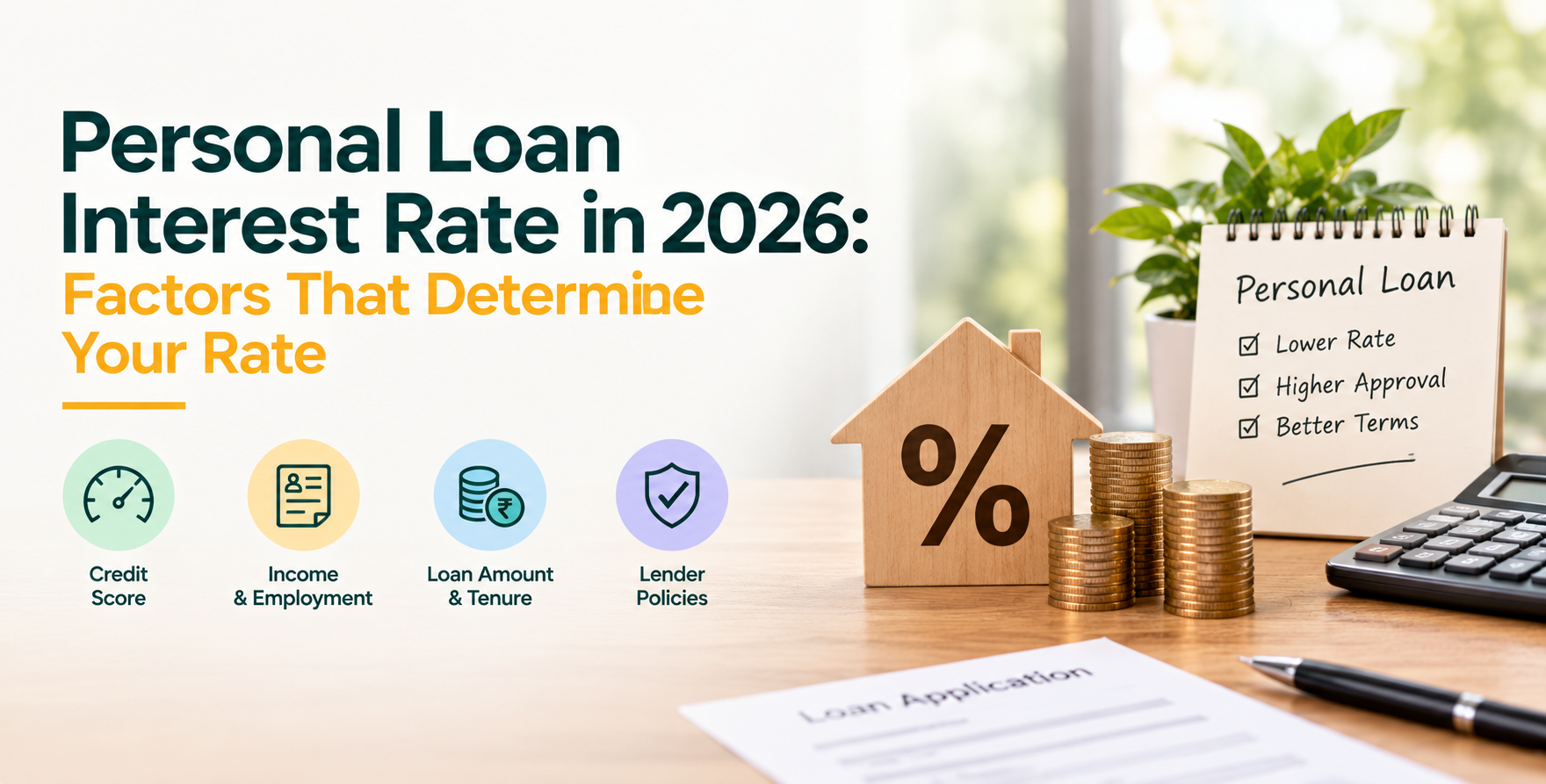
Personal Loan Interest Rate in 2026: Factors That Determine Your Rate
A personal loan interest rate determines how much interest you pay on the amount you borrow. However, two people applying for the same loan amount may not always receive the same interest rate. This is because lenders consider factors such as financial standing, credit history, income, and repayment capacity before determining the applicable rate. Understanding these factors can help you make a more informed borrowing decision.
What Is a Personal Loan Interest Rate?
A personal loan interest rate is the percentage charged by a lender on the amount borrowed. It determines the interest component of your EMI payments and contributes to the total amount you repay.
The interest rate you receive may differ from an advertised starting rate because lenders may consider your creditworthiness and other financial factors when determining the applicable rate. It is therefore necessary to establish the interest rate applicable to your particular loan rather than relying only on an advertised starting rate.
What Determines Your Personal Loan Interest Rate?
Your personal loan interest rate may depend on factors such as your credit profile, income, existing debt obligations, loan amount, repayment tenure, and the lender’s risk assessment.
Credit Score and Credit History
Your credit profile helps lenders assess your past credit and repayment behaviour. On-time payments and good management of credit facilities can contribute to a healthier credit profile. Missed payments, defaults, frequent credit applications, and high credit utilisation may indicate higher credit risk. There is no exact credit score that guarantees a specific interest rate.
Income and Employment Stability
Income and employment stability can help lenders assess your ability to repay the loan. A steady income may provide an indication of your capacity to manage EMI payments. The nature and stability of employment may also be taken into account. For self-employed borrowers, factors such as business income, cash flow, and overall financial stability may also be considered.
Existing Loans and Repayment Obligations
Your current EMIs, credit card payments, and other debt obligations may affect your overall financial profile. If a significant portion of your income is already committed to debt repayments, taking on additional borrowing may involve higher repayment risk. However, having an existing loan does not automatically mean that you will receive a higher interest rate.
Loan Amount and Tenure
The loan amount and repayment tenure may influence the lender’s assessment. A higher loan amount means greater repayment exposure, while a longer tenure can affect the EMI and total interest payable. However, neither factor automatically means that the interest rate will be higher.
Lender’s Cost and Risk Assessment
The lender may also consider its cost of funds, operational expenses, risk premium, market conditions, the nature of the loan, and other relevant factors. This means that the interest rate may differ depending on the lender or even the type of loan being offered.
Does Your Credit Score Affect Your Personal Loan Interest Rate?
Yes, your CIBIL score and credit history may influence how lenders assess your creditworthiness. However, your credit score is not the only factor considered when determining a personal loan interest rate.
Other considerations that may be taken by the lender while setting an appropriate interest rate on your loan include income levels, indebtedness, employment stability, loan amount, and other relevant factors.
Also Read: CIBIL Score Range Explained: Is your Score Good or Bad?
How to Get a Better Personal Loan Interest Rate
There are different ways in which you can improve your borrowing profile:
- Maintain a healthy credit history and review your credit report regularly.
- Pay EMIs and credit-card dues on time.
- Avoid taking on excessive debt.
- Maintain stable income and manage your existing financial obligations responsibly.
- Choose a loan amount that you can comfortably repay.
- Compare the interest rate, processing fee, and other applicable charges.
Before taking out the loan, read the sanction letter and the Key Fact Statement (KFS).
The applicable interest rate and fees must be disclosed to borrowers through the relevant loan documents.
How to Compare Personal Loan Offers in 2026
When comparing personal loan offers, don’t look at the interest rate alone. Consider the EMI, repayment tenure, processing fee, other applicable charges, prepayment or foreclosure terms, and total repayment amount.
A loan with a slightly different interest rate may have a different overall cost because of fees or tenure. Reviewing all these factors gives you a clearer picture of what the borrowing will actually cost.
Final Takeaway
A personal loan interest rate is determined by multiple factors rather than a single variable. The borrower’s credit score, income, liabilities, loan amount, repayment tenure, lender’s risk assessment, and other relevant circumstances may be considered when determining the applicable rate.
You can also explore your eligibility for a personal loan with Ram Fincorp based on your financial requirements.
FAQs
1. What factors determine a personal loan interest rate?
A personal loan interest rate may depend on factors such as your credit history, income, employment or business stability, existing debt obligations, loan amount, repayment tenure, and the lender’s risk assessment.
2. Does my CIBIL score affect my personal loan interest rate?
Yes, your CIBIL score and credit history may influence how lenders assess your creditworthiness. However, your interest rate is not determined by your CIBIL score alone. Income, existing obligations, employment or business stability, loan amount, tenure, and other factors may also be considered.
3. Can my income affect the interest rate on a personal loan?
Yes. Your income can help lenders assess your ability to repay the loan. They may also consider your employment or business stability and existing financial obligations when evaluating your application.
4. Does loan tenure affect the personal loan interest rate?
Loan tenure may be considered when determining the terms of a personal loan. A longer tenure can reduce the EMI but may increase the total interest payable over the loan period. However, a longer tenure does not necessarily mean a higher interest rate.
5. How can I get a lower personal loan interest rate?
Maintaining a healthy credit history, paying your dues on time, managing existing debt responsibly, and maintaining stable income may support a stronger borrowing profile. You can also compare different loan offers based on the interest rate, fees, tenure, and total repayment amount.
6. What should I check apart from the personal loan interest rate?
Before accepting a loan offer, check the interest rate, EMI, repayment tenure, processing fee, other applicable charges, prepayment or foreclosure terms, and total repayment amount. You should also review the sanction letter and Key Fact Statement (KFS) carefully.
Recent Posts
SimpleTransparentSecure
